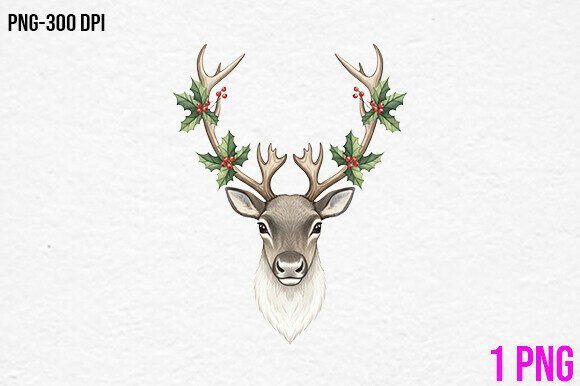
Review: Christmas Deer Head with Holly PNG for Embroidery
As a designer who has spent countless hours digitizing and testing artwork for machine embroidery, I have learned that not every pretty image translates well to thread. When I first opened the Christmas Deer Head with Holly PNG, my initial reaction was one of cautious optimism. The silhouette is classic, evoking that warm, nostalgic holiday feeling that customers crave in December. However, seeing an image on a screen is vastly different from watching it stitch out on a textured towel or a stretchy sweatshirt. This review breaks down how this specific illustration holds up when moved from a digital asset to a tangible, stitched reality.
First Impressions and Visual Personality
The mood of this design is immediately festive without being overly cluttered. The deer head serves as a strong central anchor, while the holly adds a necessary pop of seasonal context. For those of us working in the realm of Illustrations, the balance between negative space and detail is crucial. In this case, the layout feels open enough to allow the stitches to breathe, which is vital for maintaining clarity. If the details were too tight, we would risk thread breaks or a muddy appearance after washing. The visual personality here is elegant yet approachable, making it suitable for a wide range of demographics, from young families looking for baby items to adults seeking sophisticated holiday decor.
Real-World Application: The Tote Bag Test
To truly evaluate a design, you must imagine it on a physical product. I recently considered this design for a custom order of canvas tote bags for a local boutique. Canvas has a distinct weave, and lightweight designs can sometimes get lost in the texture. I found that the bold lines of the deer head held up remarkably well against the fabric grain. The holly leaves provided enough surface area for solid fill stitches, ensuring the greenery didn’t look sparse.
This scenario highlights why this machine embroidery design works well for handmade products intended for daily use. It is not so delicate that it will fray after a few washes, nor is it so dense that it stiffens the bag unnecessarily. For an Etsy seller or small shop product creator, this reliability is key to building customer trust. Buyers want a personalized gift that lasts, and a clean, well-executed stitch-out delivers exactly that.
Versatility Across Product Lines
Beyond tote bags, I see significant potential for this artwork in custom apparel. Imagine this stitched on the left chest of a heather grey sweatshirt embroidery project. The contrast between the dark thread of the deer and the soft fabric creates a high-end, boutique look. It also translates beautifully to embroidered patch production. Patches require clear boundaries and strong outlines, both of which this design seems to possess based on its structural integrity.
For those focusing on baby embroidery, such as onesies or burp cloths, the design’s simplicity is an asset. Complex, tiny details often irritate sensitive skin or pull on delicate knits. This deer head avoids those pitfalls, offering a charming motif that remains soft to the touch. It also fits seamlessly into holiday embroidery collections for home goods, such as pillow covers or kitchen towels, where a single, striking image often looks better than a busy pattern.
Technical Considerations and Fabric Challenges
While the design is versatile, there are areas where caution is required. As an experienced reviewer, I always advise checking the stitch density before committing to a large run. If the holly leaves are digitized with heavy satin stitches, they may pucker on thin fabrics like silk or lightweight cotton. Always use an appropriate stabilizer to counteract this. For stretchy fabrics, such as jersey knits used in t-shirts, a cut-away stabilizer is non-negotiable to prevent distortion.
Another critical factor is hoop size. Ensure that the dimensions of the Christmas Deer Head with Holly PNG fit comfortably within your standard hoops without requiring excessive re-hooping, which can lead to misalignment. Additionally, consider the background color. On dark fabrics, you may need to adjust your thread colors or add an underlay to ensure the design pops. A test stitch on scrap fabric is essential here. Do not skip this step. Seeing how the running stitch outlines interact with the fill stitch areas on your specific machine can save you from costly mistakes.
Commercial Viability and Branding
For commercial embroidery professionals, the value of a design lies in its ability to enhance brand perception. This illustration offers a polished look that elevates the perceived value of the finished product. It is not just a clipart image; when stitched correctly, it becomes a premium feature. This helps in creating consistent branding across various items, from aprons to caps. Customers are more likely to engage with and share photos of products that look professional and well-crafted.
If you are a digital product seller offering this as a digital embroidery file, make sure to provide clear previews. Use printable mockup tools to show the design on different backgrounds. This helps buyers visualize the end result and reduces return requests due to mismatched expectations. Remember, always confirm licensing terms before selling finished items. Some design assets allow for commercial use of the physical product but restrict the resale of the digital file itself.
Final Designer Notes
Before you launch your next embroidery project, take a moment to review the technical specs of this file. Check if it is optimized as an applique design or a full embroidery file, as this changes your material requirements. Inspect small details for potential thread breaks. Compare how it looks in black and white to ensure the shape is recognizable even without color variation. By treating this Christmas Deer Head with Holly PNG with the same rigor you would apply to any high-stakes client work, you ensure that your final output is not just festive, but professionally flawless.